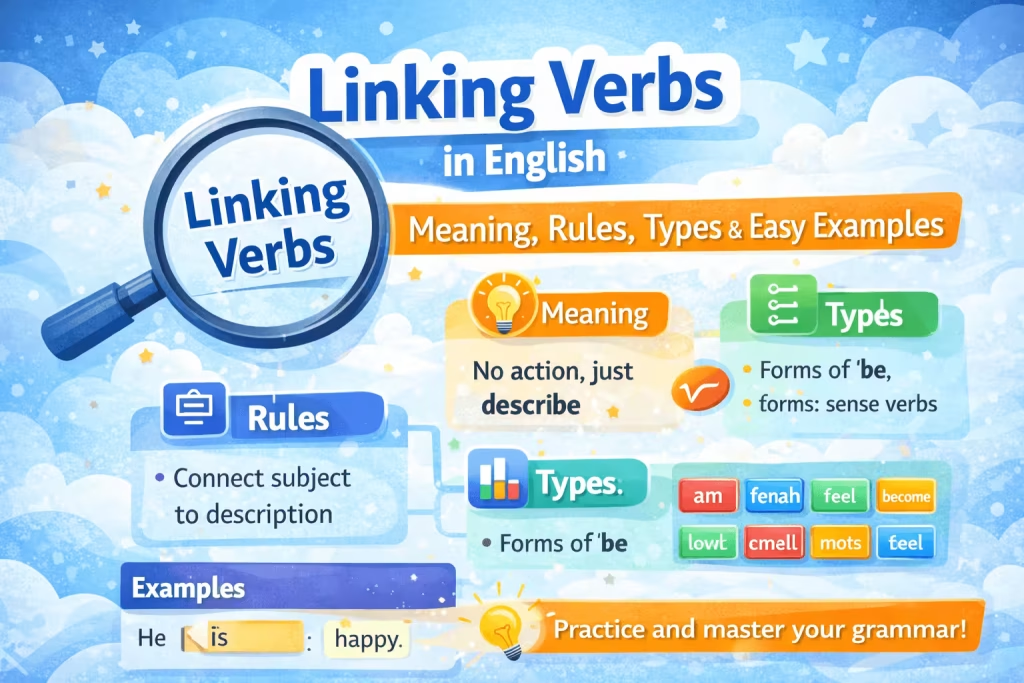
What Are Linking Verbs and Why Do We Use Them?
English grammar is like a bridge that connects words to meaning. However, some verbs do not show action at all. Instead, they quietly connect ideas. These special verbs are called linking verbs.
In daily life, meaningfully, we use linking verbs when we:
- Describe people
- Talk about feelings
- Explain states or conditions
- Share opinions
For example, when you say “She is happy”, you are not showing an action. Rather, you are describing a feeling. Therefore, the verb is links the subject she to the word happy.
Because linking verbs are everywhere in conversations, stories, textbooks, and exams. it is essential to understand them clearly. So, in this lesson, we will explore linking verbs step by step in a simple, child-friendly, and engaging way.
Offering clear explanations, examples, rules, and practice, this lesson will help you use linking verbs with confidence.
Definition Section
Beginner Definition
A linking verb does not show action. Instead, it tells us what the subject is like.
Grammar Definition
A linking verb connects the subject to a subject complement (a noun or adjective that gives more information about the subject).
In short:
Linking verbs connect, not act.
3What Linking Verbs Do NOT Do (Very Important)
Before going deeper, let’s clear confusion.
Linking verbs do NOT:
- show action
- show movement
- answer “What is happening?”
Linking verbs DO:
- describe the subject
- rename the subject
- explain feelings or states
Because of this, linking verbs are often misunderstood. However, once this point is clear, everything becomes easier.
Types of Linking Verbs
Linking verbs fall into three main types. Let’s explore them one by one.
Type 1: Forms of BE
These are the most common linking verbs.
List:
- am, is, are
- was, were
- be, been, being
Examples:
- She is smart.
- They are ready.
- The test was easy.
Type 2: Sense Linking Verbs
(When They Describe, Not Act)
These verbs relate to the five senses.
List:
- look
- feel
- taste
- smell
- sound
Examples:
- The cake tastes sweet.
- He feels tired.
- The music sounds loud.
Important:
These verbs are linking only when they describe, not when they show action.
Type 3: Change or State Verbs
These verbs show change or condition, not action.
List:
- become
- seem
- appear
- remain
- grow
Examples:
- She became a teacher.
- He seems happy.
- The weather grew cold.
Step-by-Step Understanding
Now, let’s understand how to identify linking verbs correctly.
Step 1: Find the Subject
Ask: Who or what is the sentence about?
Step 2: Look at the Verb
Ask: Does this verb show action?
Step 3: Look After the Verb
- Adjective → linking verb
- Noun → linking verb
- Verb → NOT linking
Step 4: Use the “IS Test” (Powerful Trick)
Replace the verb with is.
- If the sentence still makes sense → linking verb
- If not → action verb
Example:
- She looks happy → She is happy ✅
- She looks at me → She is at me ❌
Linking Verb vs Action Verb (Clear Comparison)
| Sentence | Verb Type |
|---|---|
| She looks happy. | Linking |
| She looks at the sky. | Action |
| The soup smells good. | Linking |
| She smells the soup. | Action |
Therefore, context decides the verb type, not the verb alone.
Examples Table (20+ Easy Sentences)
| No. | Sentence | Verb |
|---|---|---|
| 1 | She is happy. | is |
| 2 | The cake tastes sweet. | tastes |
| 3 | He became a doctor. | became |
| 4 | The sky looks blue. | looks |
| 5 | I feel tired. | feel |
| 6 | They are excited. | are |
| 7 | The soup smells good. | smells |
| 8 | The test was easy. | was |
| 9 | He seems angry. | seems |
| 10 | The music sounds loud. | sounds |
| 11 | She remained calm. | remained |
| 12 | The child grew sleepy. | grew |
| 13 | The book is interesting. | is |
| 14 | The room feels cold. | feels |
| 15 | He appeared nervous. | appeared |
| 16 | The flowers smell fresh. | smell |
| 17 | The dress looks beautiful. | looks |
| 18 | I am ready. | am |
| 19 | The weather became hot. | became |
| 20 | The answer was correct. | was |
Rules & Patterns
Rule 1: Linking verbs do not show action
Linking verbs never show an action like running, jumping, or eating.
Instead, they connect the subject to information that describes or explains it.
They tell us:
- What the subject is
- How the subject feels
- What the subject seems like
Examples:
- She is happy. (no action — feeling)
- The soup tastes good. (no action — description)
- He became a teacher. (no action — state)
Rule 2: Adjectives follow linking verbs
✔ She feels happy
❌ She feels happily
Rule 3: Sentence Pattern
Subject + Linking Verb + Description
Examples:
- He is kind.
- The food tastes delicious.
Rule 4: Same Verb, Different Role
- Linking → describes subject
- Action → shows action
Why Linking Verbs Matter in Real Life
Linking verbs help you:
- Describe emotions clearly
- Write better essays
- Speak naturally
- Avoid common grammar mistakes
Because exams and real conversations often test description and clarity, mastering linking verbs improves your overall English fluency.
Common Mistakes (With Fixes)
Mistake 1: Using adverbs
She feels happily.
✔ She feels happy.
Mistake 2: Thinking all verbs show action
He is running. (is = helping verb, not linking)
Mistake 3: Misjudging sense verbs
She smells the flower. (action)
The flower smells nice. (linking)
Exercises Section (20 Questions)
A. Identify the Linking Verb (5)
- She is tired.
- The cake tastes sweet.
- He became angry.
- The room feels cold.
- The sky looks clear.
B. Fill in the Blanks (10)
- She ___ happy.
- The soup ___ good.
- He ___ a teacher.
- The music ___ loud.
- I ___ ready.
- They ___ excited.
- The flowers ___ fresh.
- The test ___ easy.
- He ___ nervous.
- The weather ___ cold.
C. Write Your Own Sentences (5)
- Use is as a linking verb.
- Use feels in a sentence.
- Use became correctly.
- Write a sentence with looks.
- Write any sentence with a linking verb.
Answer Key
- is
- tastes
- became
- feels
- looks
- is
- smells/tastes
- became
- sounds
- am
- are
- smell
- was
- seems
- became
Mini Quiz (10 Questions)
- Linking verbs show action. (False)
- “Is” can be a linking verb. (True)
- Linking verbs connect the subject to a description. (True)
- Adverbs follow linking verbs. (False)
- “Feels” can be linking. (True)
- All verbs are linking verbs. (False)
- “Became” is a linking verb. (True)
- Linking verbs show movement. (False)
- “Looks happy” uses a linking verb. (True)
- Linking verbs are common in daily English. (True)
Creative Activity: Story Builder for Kids
Write a short story using:
- 3 linking verbs
- 2 adjectives
- 1 feeling
Story Starter:
Today, the weather was warm. I felt excited, and my friend seemed happy.
Summary
Linking verbs connect, not act
They describe feelings and states
Common types: be, sense verbs, change verbs
Adjectives follow linking verbs
Leave a Reply