Introduction
In English, some small words create big confusion.
One of the most confusing pairs is “lay” and “lie.”
At first, they look almost the same.
However, when we use them in sentences, the meaning can change completely.
For example, many learners say:
❌ I will lay down now.
Although this sounds normal, it is not correct.
Therefore, learning the difference between lay and lie is very important.
In fact, we use these words every day—at home, at school, and while speaking casually.
For instance:
- lying on a bed
- laying a book on a table
- lying on the grass
- laying clothes on a chair
As a result, if you learn this topic well, your English will immediately sound clearer and more confident.
Definition Section
Before going deeper, let’s first understand the basic meanings.
What Does Lie Mean?
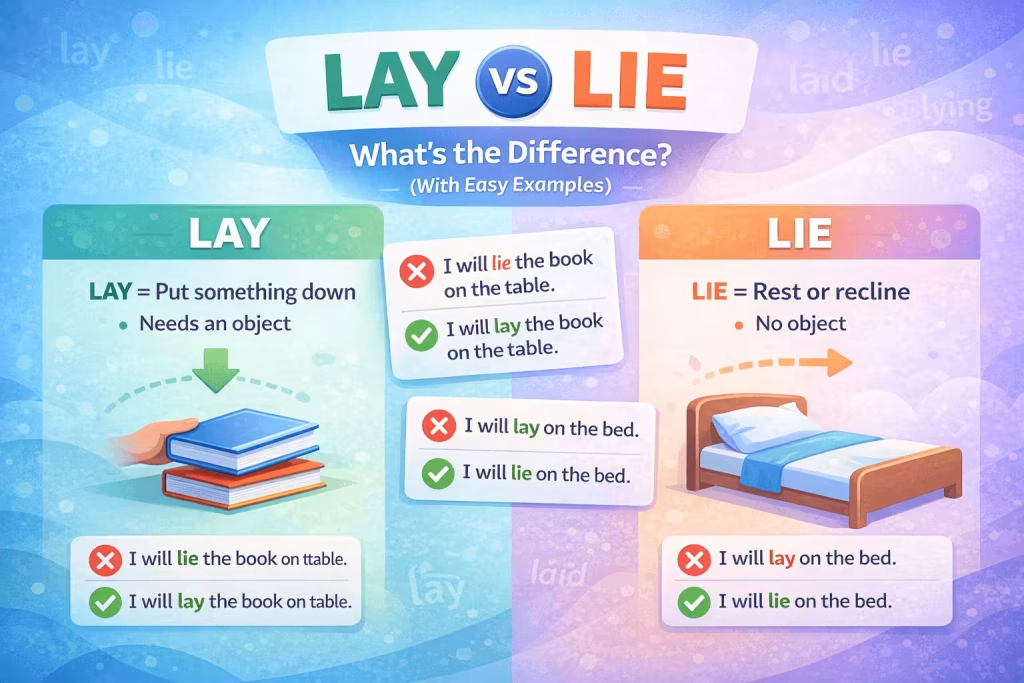
Lie means:
- to rest
- to recline
- to be in a flat position
In other words, the subject does the action alone.
For example:
- I lie on the bed.
- The cat lies on the sofa.
Most importantly, lie does NOT take an object.
What Does Lay Mean?
On the other hand, lay means:
- to put something
- to place one thing on another
In this case, an object is always involved.
For example:
- I lay the book on the table.
- She lays the baby in the crib.
Therefore, whenever you move something, lay is the correct choice.
Easy Memory Trick
If something is resting → lie
If something is being placed → lay
Because of this rule, you can decide quickly and confidently.
Step-by-Step Breakdown
Now, let’s understand this topic step by step, just like a teacher in a classroom.
Step 1: Ask Yourself One Question
Before choosing a word, always ask:
Am I resting, or am I putting something?
If you are resting, choose lie.
However, if you are placing something, choose lay.
Step 2: How to Use Lie Correctly
Use lie when:
- someone rests
- someone reclines
- someone is already in a position
For example:
- I lie down after school.
- He lies on the floor.
- They are lying under the tree.
Notice that no object comes after lie.
Because of this, sentences like the following are wrong:
❌ I lie the book on the table.
Step 3: How to Use Lay Correctly
Now, let’s look at lay.
Use lay when:
- you put something
- you place one thing somewhere
For example:
- I lay the phone on the desk.
- She lays her bag near the door.
- He laid the keys on the table.
As you can see, lay always needs an object.
4. Verb Forms — The Real Reason for Confusion
At this point, many learners feel confused.
That is because the past forms look similar.
Forms of Lie (to rest)
| Tense | Form |
|---|---|
| Present | lie / lies |
| Past | lay |
| Past Participle | lain |
| -ing | lying |
For example:
- Today, I lie down.
- Yesterday, I lay down.
- I have lain here all day.
Forms of Lay (to put something)
| Tense | Form |
|---|---|
| Present | lay / lays |
| Past | laid |
| Past Participle | laid |
| -ing | laying |
For example:
- I lay the book here.
- Yesterday, I laid the book here.
- I have laid the book here.
Therefore, although the forms look confusing, the meaning stays clear.
Examples Table (20+ Real Life Sentences)
| Sentence | Correct Word |
|---|---|
| I want to ___ down now. | lie |
| Please ___ the bag here. | lay |
| The dog is ___ on the floor. | lying |
| She ___ the baby gently. | laid |
| He likes to ___ in the sun. | lie |
| ___ your books on the shelf. | Lay |
| The phone is ___ on the bed. | lying |
| She ___ her jacket on the chair. | laid |
| I am ___ down to rest. | lying |
| They ___ the picnic cloth. | laid |
| The baby ___ quietly. | lies |
| He ___ the papers carefully. | lays |
| The cat has ___ there all day. | lain |
| I ___ my head on the pillow. | lay |
| She ___ awake at night. | lies |
| He ___ the gift on the table. | laid |
| We are ___ the mats outside. | laying |
| The child ___ on the grass. | lies |
| I have ___ the keys here. | laid |
| The book is ___ on the desk. | lying |
Rules & Patterns (Quick Review)
Golden Rules
- First, remember: lie = no object
- Next, remember: lay = needs an object
- If something is resting, use lie
- If something is placed, use lay
Sentence Patterns
- Lie Pattern:
Subject + lie/lies/lying I lie down. - Lay Pattern:
Subject + lay/lays/laid + object I lay the book down.
Why This Matters in Real Life
In real life, grammar mistakes can cause confusion.
Therefore, using lay and lie correctly helps you:
- sound more natural
- speak with confidence
- write better sentences
- avoid common exam mistakes
As a result, your English becomes clear and professional.
Common Mistakes & Easy Fixes
Mistake 1
❌ I will lay down.
✅ I will lie down.
Mistake 2
❌ The book is laying there.
✅ The book is lying there.
Mistake 3
❌ I lied the phone on the table.
✅ I laid the phone on the table.
Exercises (20 Questions)
A) Fill in the Blanks (10)
- I want to ___ down.
- Please ___ the pen here.
- The baby is ___ asleep.
- She ___ the dress on the bed.
- He has ___ here for hours.
- ___ the book gently.
- I am ___ under the tree.
- She ___ the keys yesterday.
- The dog ___ quietly.
- We are ___ the blankets.
B) Choose the Correct Word (5)
- I (lie / lay) on the couch.
- She (lie / lay) the bag down.
- The cat is (lying / laying) there.
- He has (lain / laid) the papers.
- They (lie / lay) awake at night.
C) Make Your Own Sentences (5)
- Use lie
- Use lay
- Use lying
- Use laid
- Use lain
Answer Key
- lie
- lay
- lying
- laid
- lain
- Lay
- lying
- laid
- lies
- laying
- lie
- lay
- lying
- laid
- lie
Mini Quiz (10 Questions)
- Lay needs an object. ✅
- Lie needs an object. ❌
- Lain is from lie. ✅
- Laid is from lay. ✅
- You can “lie a book.” ❌
- You can “lay a baby.” ✅
- Lying means resting. ✅
- Lay works alone. ❌
- Practice helps learning. ✅
- Grammar improves confidence. ✅
Creative Story Builder
Tom came home tired, so he decided to ___ on his bed.
Meanwhile, his mother ___ his bag near the door.
The cat was already ___ on the sofa.
Finally, Tom ___ his book beside him and slept.
Short Summary
- Lie = rest (no object)
- Lay = put something (needs object)
- Past forms cause confusion, but rules stay simple
- Practice makes everything easier
Leave a Reply