Introduction
Have you ever tried to speak or write a sentence and wondered, “Is this a full sentence, or does something feel missing?”
If yes, then you are already thinking about clauses even if you didn’t know the name.
In everyday life, we use clauses when:
- Talking to friends
- Writing school essays
- Reading stories
- Sending messages and emails
Therefore, learning Independent and Dependent Clauses helps you:
- Make complete sentences
- Avoid grammar mistakes
- Write more clear, confident English
So, let’s learn this topic step by step slowly, clearly, and in a fun way
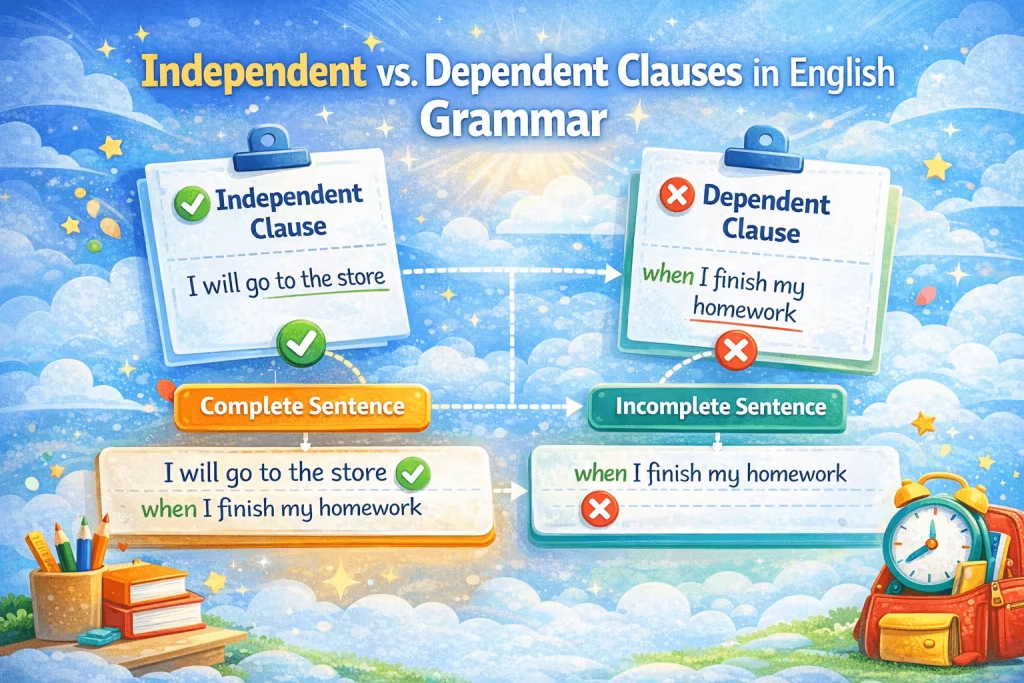
Independent vs. Dependent Clauses
What Is a Clause?
A clause is a group of words that has:
- a subject (who or what)
- a verb (what happens)
However, not all clauses are the same.
Independent Clause
An independent clause:
- has a subject + verb
- gives a complete idea
- can stand alone as a sentence
It does not need help from another clause.
Example:
She likes ice cream.
This sentence feels complete. So, it is an independent clause.
Dependent Clause
A dependent clause:
- has a subject + verb
- does NOT give a complete idea
- cannot stand alone
- needs help from an independent clause
Alone, it feels unfinished.
Example:
Because she likes ice cream.
This sounds incomplete. We ask: What happened because she likes ice cream?
Therefore, it is a dependent clause.
Step-by-Step Breakdown
Step 1: Understanding Independent Clauses
An independent clause:
- starts with a normal subject
- uses a main verb
- expresses a full thought
Examples:
- I finished my homework.
- The dog barked loudly.
- We went to the park.
Important Tip:
If you can put a full stop (.) at the end and feel satisfied, it’s independent.
Step 2: Understanding Dependent Clauses
A dependent clause often begins with:
- because
- when
- although
- if
- while
- since
These words are called subordinating conjunctions.
Examples:
- because it was raining
- when I reached home
- although she was tired
These clauses leave us waiting for more information.
Step 3: How They Work Together
Most sentences use both clauses together.
Pattern:
Dependent Clause + Independent Clause
Independent Clause + Dependent Clause
Example:
- Because it was raining, we stayed inside.
- We stayed inside because it was raining.
Both are correct
Examples Table (20+ Examples)
| No. | Independent Clause | Dependent Clause |
|---|---|---|
| 1 | I stayed home | because I was sick |
| 2 | She smiled | when she saw the gift |
| 3 | We canceled the trip | because it was raining |
| 4 | He passed the test | although it was difficult |
| 5 | The baby slept | while the music played |
| 6 | I will call you | when I arrive |
| 7 | They laughed | because the joke was funny |
| 8 | She kept running | even though she was tired |
| 9 | We can go out | if the weather is good |
| 10 | He waited | until the bus arrived |
| 11 | I remember the day | when we first met |
| 12 | She helped me | because I asked |
| 13 | We stopped playing | when it got dark |
| 14 | The match continued | although it was late |
| 15 | I felt happy | when I heard the news |
| 16 | He stayed calm | while others panicked |
| 17 | She studied harder | after she failed once |
| 18 | The dog barked | because it heard a noise |
| 19 | We cheered | when our team won |
| 20 | I stayed silent | although I was angry |
Rules + Patterns (Easy to Remember)
Rules for Independent Clauses
Must have subject + verb
Makes sense alone
Can end with a period
Pattern:
Subject + Verb + Object
Rules for Dependent Clauses
✔ Has subject + verb
✔ Starts with words like because, when, although
❌ Cannot stand alone
Pattern:
Subordinating Word + Subject + Verb
Comma Rule (Very Important!)
- When a dependent clause comes at the beginning of a sentence, place a comma after it.
- When an independent clause comes first, you do not need a comma.
Why This Matters in Real Life
Learning clauses helps you:
- Write better school essays
- Speak clear English
- Avoid sentence fragments
- Improve IELTS, TOEFL, and exams
- Sound confident in conversations
Therefore, this skill is useful every single day.
Common Mistakes (And Fixes)
Mistake 1: Writing dependent clauses alone
Wrong: Because I was tired.
Correct: I slept early because I was tired.
Mistake 2: Forgetting commas
Wrong: When I finished my work I went home.
Correct: When I finished my work, I went home.
Mistake 3: Confusing phrases with clauses
A clause must have a verb.
Exercises Section (20 Questions)
A. Fill in the Blanks
- I stayed inside _____ it was cold.
- She smiled _____ she saw me.
- We will play _____ it stops raining.
- He ran fast _____ he was late.
- I felt proud _____ I won.
B. Identify the Clause Type
- She finished her work.
- Because he was tired
- When the bell rang
- They went home early.
- Although it was noisy
C. Make Your Own Sentences
11–15. Write 5 sentences using independent clauses.
16–20. Write 5 sentences using dependent + independent clauses.
Answer Key
- because
- when
- if
- because
- when
- Independent
- Dependent
- Dependent
- Independent
- Dependent
(11–20: Student answers may vary)
Mini Quiz (10 Questions)
Choose the Correct Answer
- Which clause can stand alone?
a) Dependent
b) Independent ✅ - “Because I was late” is:
a) Independent
b) Dependent ✅ - A dependent clause often starts with:
a) Noun
b) Subordinating word ✅ - True or False:
An independent clause needs another clause. ❌ - True or False:
A dependent clause has a subject and verb. ✅
(6–10: Continue similarly)
Creative Activity: Story Builder for Kids
Fun Task:
Write a 5-line story using:
- 3 independent clauses
- 2 dependent clauses
Example:
I went to the park because it was sunny.
I played on the swing.
When I got tired, I sat down.
I ate ice cream.
I went home happy.
Summary of Learning
In this lesson, you learned how sentences are built using independent and dependent clauses. An independent clause gives a full idea and can stand alone, while a dependent clause feels unfinished and needs another clause to complete its meaning. Understanding this difference helps you recognize why some sentences sound complete and others do not.
Most importantly, this lesson showed how using clauses correctly helps you:
- Write clear and complete sentences
- Avoid sentence fragments
- Improve spoken and written English
- Score better in school exams, IELTS, and competitive tests
- Communicate ideas with confidence and accuracy
By understanding and practicing independent vs. dependent clauses, you are building a strong foundation in English grammar that will support advanced topics like complex sentences, conjunctions, and paragraph writing.
Leave a Reply