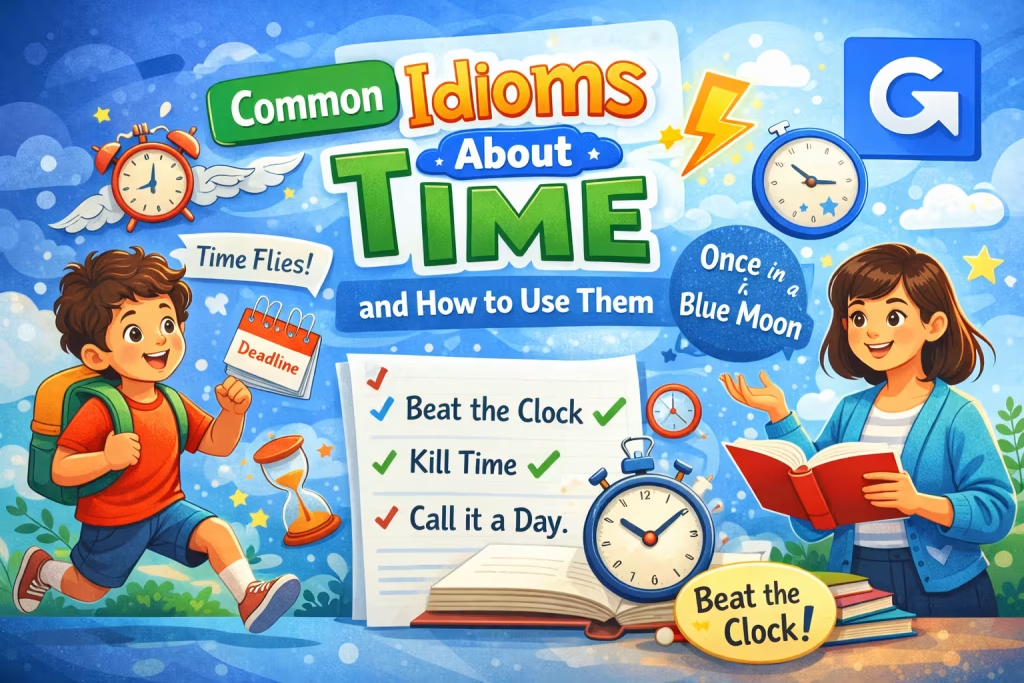
What Are Idioms About Time?
Every day, our lives move with time. We talk about time when we wake up, go to school, finish homework, play with friends, or plan for the future. Because time is so important, English uses many idioms about time to express ideas in a colorful and natural way.
Idioms about time are commonly used:
- In daily conversations
- In stories and cartoons
- In movies and TV shows
- In spoken and written English
If you want to sound more natural, fluent, and confident, learning time idioms is very helpful. Therefore, this lesson will guide you step by step, just like a friendly teacher in a classroom.
Definition
Simple Definition:
Idioms about time are fixed expressions that talk about time but do not mean exactly what the words say.
Another Easy Way to Understand:
- The words sound simple
- But the meaning is special
- You cannot guess the meaning word by word
Example:
“Time flies”
It does NOT mean time has wings
It means time passes very quickly
So, idioms about time help us talk about speed, delay, past, present, future, and habits in a fun and natural way.
How Idioms About Time Work (Step by Step)
Let us understand idioms about time slowly and clearly.
Step 1: Idioms are Fixed
You cannot change the words in an idiom.
- time flies
- time flies fastly (wrong)
Step 2: Meaning Is Figurative
The meaning is not literal.
- “Behind the times” = old-fashioned
- Not someone standing behind a clock
Step 3: Used in Specific Situations
Each idiom fits special situations, such as:
- Being late
- Acting quickly
- Waiting
- Remembering the past
- Planning the future
Because of this, learning idioms improves real-life English, not just exam English.
20 + Idioms About Time
| Idiom | Meaning | Example Sentence |
|---|---|---|
| Time flies | Time passes quickly | Time flies when we are having fun. |
| In the nick of time | Just before it is too late | She arrived in the nick of time. |
| Once in a blue moon | Very rarely | He visits us once in a blue moon. |
| Beat the clock | Finish before time ends | We beat the clock and won. |
| Around the clock | All day and night | Doctors work around the clock. |
| Call it a day | Stop working | Let’s call it a day now. |
| Kill time | Do something while waiting | I read books to kill time. |
| Out of time | No time left | We are out of time now. |
| Time is money | Time is valuable | Do not waste time—time is money. |
| On time | Not late | The bus arrived on time. |
| Behind the times | Old-fashioned | That phone is behind the times. |
| Ahead of time | Earlier than expected | I finished my work ahead of time. |
| At the last minute | Very late | He studied at the last minute. |
| Take your time | Do not hurry | Take your time and relax. |
| Pressed for time | Very busy | I’m pressed for time today. |
| Time after time | Again and again | She wins time after time. |
| From time to time | Sometimes | I visit my uncle from time to time. |
| Make time | Create time | I make time for my family. |
| Have time on your hands | Free time | I have time on my hands today. |
| Against the clock | In a hurry | We worked against the clock. |
Rules & Patterns: How to Use Time Idioms Correctly
Important Rules:
- Do NOT change the words
- Use idioms naturally in sentences
- Match the situation correctly
Common Patterns:
- Subject + idiom
- Time flies.
- Verb + idiom
- Let’s call it a day.
- Preposition + idiom
- In the nick of time
Tip for Learners:
Learn idioms with examples, not alone.
Why Idioms About Time Matter in Real Life
Idioms about time are important because:
- They make your English sound natural
- Native speakers use them every day
- They help you understand movies and stories
- They improve speaking and writing skills
In real life, people rarely speak only simple sentences. Therefore, idioms help you connect with real English.
Common Mistakes (And How to Fix Them)
Mistake 1: Taking Idioms Literally
Fix: Learn the meaning, not the words
Mistake 2: Changing Idiom Words
Fix: Memorize the full idiom
Mistake 3: Using in Wrong Situation
Fix: Learn example sentences
Mistake 4: Overusing Idioms
Fix: Use them naturally, not in every sentence
Exercises Section
A. Fill in the Blanks (10 Questions)
- Time ______ when you are happy.
- He came in the ______ of time.
- I read books to ______ time.
- Let’s ______ it a day.
- She is always ______ the clock.
- He visits us once in a ______ moon.
- I am pressed for ______ today.
- The train arrived ______ time.
- Please take your ______.
- We ran out of ______.
B. Choose the Correct Idiom (5 Questions)
- Very rarely
a) time flies
b) once in a blue moon
c) call it a day - Finish early
a) behind the times
b) ahead of time
c) kill time - Stop working
a) call it a day
b) beat the clock
c) around the clock - Free time
a) pressed for time
b) time on your hands
c) against the clock - Just before late
a) out of time
b) nick of time
c) from time to time
C. Make Your Own Sentences (5 Questions)
- Use “time flies”
- Use “take your time”
- Use “once in a blue moon”
- Use “call it a day”
- Use “ahead of time”
Answer Key
Fill in the Blanks:
- flies
- nick
- kill
- call
- against
- blue
- time
- on
- time
- time
Correct Idiom:
11. b
12. b
13. a
14. b
15. b
(Sentence answers may vary.)
Mini Quiz (10 Questions)
True or False
- Idioms always mean exactly what they say. ❌
- “Time flies” means time moves fast. ✔
- Idioms can be changed easily. ❌
- “Call it a day” means stop working. ✔
- “Once in a blue moon” means often. ❌
- Idioms improve spoken English. ✔
- “Ahead of time” means late. ❌
- Idioms are used in daily life. ✔
- “Kill time” means waste life. ❌
- Idioms make English interesting. ✔
Creative Activity: Story Builder for Kids
Task:
Write a short story (5–7 lines) using at least 3 time idioms.
Example Starter:
“Time flies during summer holidays. One day, I finished my homework ahead of time and decided to call it a day…”
Summary
In this lesson, you learned:
- What idioms about time are
- How they work
- 20+ common time idioms
- Real-life usage
- Mistakes to avoid
- Practice through exercises and quizzes
Now, you are one step closer to fluent and natural English.
Leave a Reply