Introduction
If you have ever finished writing something and thought,
“Okay, I’ll just check it quickly,”
you are not alone.
Students, ESL learners, bloggers, job seekers, and even teachers often mix up revising, editing, and proofreading. Many people think they are the same thing. Others do them in the wrong order. Some skip one stage completely.
This masterclass will remove all confusion.
By the end of this lesson, you will:
- Clearly understand revising vs editing vs proofreading
- Know exactly when and how to use each stage
- See real examples (lots of them!)
- Practice step by step like a real writing class
- Feel confident using the full writing process for students and beginners
The Big Problem Beginners Face
Most beginners believe:
“Revising means fixing spelling.”
“Editing is checking grammar only.”
“Proofreading is reading again quickly.”
These ideas cause weak writing, low grades, and mistakes in emails and exams.
The real problem is this:
Beginners focus on small mistakes first instead of big ideas first.
Writing works from big to small, not the other way around. Let’s fix that properly.
The Writing Journey
Think of writing as making something useful:
- A story
- A school answer
- An email
- A job application
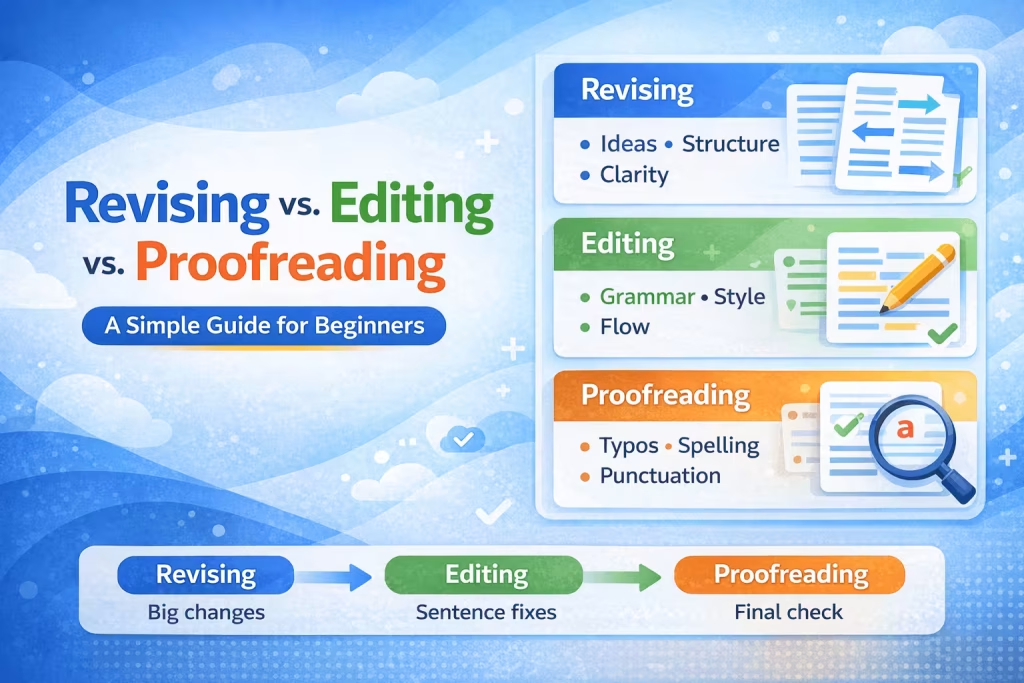
Every good piece of writing goes through three clear stages:
- Revising → Fix the ideas
- Editing → Fix the language
- Proofreading → Fix the tiny mistakes
Now let’s learn each one slowly.
Revising vs. Editing vs. Proofreading
What Is Revising?
Simple definition:
Revising means changing your ideas to make them better.
Another way to say it:
- Improving meaning
- Making ideas clearer
- Adding, removing, or moving parts
Everyday analogy (Building a House):
Revising is checking:
- Is this the right room?
- Should the kitchen be bigger?
- Is the door in the correct place?
You are not painting the walls yet.
You are checking the structure.
What Is Editing?
Simple definition:
Editing means fixing the language.
Another way to say it:
- Grammar
- Sentence structure
- Word choice
- Tense consistency
Cooking analogy:
Editing is checking:
- Is there too much salt?
- Did I use the correct ingredient?
- Is the cooking style consistent?
The dish exists but now you make it taste right.
What Is Proofreading?
Simple definition:
Proofreading means finding small surface mistakes.
Another way to say it:
- Spelling
- Punctuation
- Capital letters
- Extra spaces
Cleaning analogy:
Proofreading is:
- Wiping the table
- Cleaning fingerprints
- Polishing the final look
Nothing big changes. You just clean.
One Powerful Memory Trick (Never Forget Again)
R–E–P Formula
- Revising = Rethink ideas
- Editing = English accuracy
- Proofreading = Polish mistakes
Ideas → Language → Errors
Always in this order.
Step-by-Step Deep Explanation (What REALLY Happens)
Stage 1: Revising (Big Changes)
What you check:
- Is the main idea clear?
- Does it answer the question?
- Is anything missing?
- Is anything unnecessary?
What you DO:
- Add new sentences
- Remove weak parts
- Rearrange paragraphs
- Rewrite sections
And What you do NOT do:
Fix spelling
Correct commas
Worry about grammar perfection
Stage 2: Editing (Medium Changes)
What you check:
- Grammar rules
- Sentence clarity
- Verb tenses
- Word choice
What you DO:
- Fix sentence structure
- Improve vocabulary
- Make sentences smoother
And What you do NOT do:
Change main ideas
Add new arguments
Stage 3: Proofreading (Tiny Changes)
What you check:
- Spelling mistakes
- Capital letters
- Punctuation
- Typos
What you DO:
- Read slowly
- Read aloud
- Check one thing at a time
And What you do NOT do:
Rewrite sentences
Change ideas
Comparison Table
| Feature | Revising | Editing | Proofreading |
|---|---|---|---|
| Focus | Ideas & meaning | Language & grammar | Small errors |
| Big or small? | Big changes | Medium changes | Tiny changes |
| Add/remove content? | Yes | No | No |
| Grammar focus? | No | Yes | Very little |
| Spelling focus? | No | Sometimes | Yes |
| Best time | After first draft | After revising | Final step |
Same Sentence Through All Stages
Original Sentence (First Draft)
I like school because it is good and teachers are nice and learning helps us.
Revising (Ideas Improve)
I like school because it helps students learn new skills and become confident people.
(Meaning improved, ideas clearer.)
Editing (Language Improves)
I like school because it helps students learn new skills and become confident individuals.
(Better word choice.)
Proofreading (Errors Fixed)
I like school because it helps students learn new skills and become confident individuals.
(No errors left.)
More Quick Examples (Grouped)
| Draft | Revising | Editing | Proofreading |
|---|---|---|---|
| He go to market | Add detail | He goes to the market | (no change) |
| I was happy very | Explain why | I was very happy | (no change) |
| my teacher name is ali | Clarify sentence | My teacher’s name is Ali | Capitalize |
Rules, Patterns & Easy Formulas
Writing Process Formula
Draft → Revise → Edit → Proofread → Submit
What to Ask Yourself
Revising questions:
- What is my main message?
- Is this clear to a reader?
Editing questions:
- Are my sentences correct?
- Do verbs match time?
Proofreading questions:
- Any spelling mistakes?
- Any missing punctuation?
Why This Skill Matters in Real Life
School & Exams
- Clear answers = better marks
- Organized ideas = teacher understands you
Jobs & Emails
- Professional writing builds trust
- Fewer mistakes = strong impression
Confidence
- You stop feeling “bad at English”
- You know what to fix and when
Common Beginner Mistakes (and How to Fix Them)
Mistake 1: Proofreading First
Why it happens:
People fear grammar mistakes.
Fix:
Always revise ideas first.
Mistake 2: Editing While Writing
Why:
Trying to be perfect too early.
Fix:
Write freely first. Fix later.
Mistake 3: Skipping Revising
Why:
Revising feels hard.
Fix:
Ask simple questions about clarity.
PRACTICE SECTION (Hands-On Learning)
Exercise 1: Identify the Stage (10)
Write R, E, or P.
- Fixing spelling mistakes → ___
- Adding a missing reason → ___
- Correcting verb tense → ___
- Rearranging paragraphs → ___
- Checking commas → ___
Exercise 2: Fill in the Blanks (5)
- Revising focuses on _______.
- Editing fixes _______.
- Proofreading checks _______.
Exercise 3: Improve the Sentence (5)
Sentence:
she like read book in school
- Revising: __________
- Editing: __________
- Proofreading: __________
ANSWER KEY
Exercise 1:
- P
- R
- E
- R
- P
Exercise 2:
- ideas
- grammar and language
- spelling and punctuation
Sample: Exercise 3:
- Revising: She enjoys reading books at school because they help her learn.
- Editing: She enjoys reading books at school because they help her learn.
- Proofreading: (capital S)
Mini Quiz
Choose True (T) or False (F)
- Revising fixes spelling.
- Editing comes before revising.
- Proofreading is the final step.
- Revising can remove sentences.
- Editing improves word choice.
Answers:
- F
- F
- T
- T
- T
Creative Activity: Story Builder (Kids & Beginners)
Step-by-Step
- Write 5 simple sentences about your day.
- Revise: Add one detail to each.
- Edit: Fix grammar and verbs.
- Proofread: Fix spelling and punctuation.
You just used the full writing process!
Final Summary (Remember This Forever)
Revising builds the message, editing improves the language, and proofreading cleans the final draft.
- Revising = Improve ideas
- Editing = Improve language
- Proofreading = Fix mistakes
Ideas → Language → Errors
Master this order, and your writing will always improve.
Leave a Reply