Introduction
Have you ever said, “I’m working right now” or “She’s watching Netflix”? If so, you’ve used the Present Progressive Tense (also called the Present Continuous Tense) correctly.
This guide will take you beyond textbook definitions and help you truly master the Present Progressive.
What Is Present Progressive Tense?
The Present Progressive Tense shows actions that are happening RIGHT NOW, at this very moment. Additionally, it’s like taking a photograph of an action in progress!
Think of it as the “happening now” tense. Whenever you want to tell someone about something that’s going on as you speak, you use this special tense.
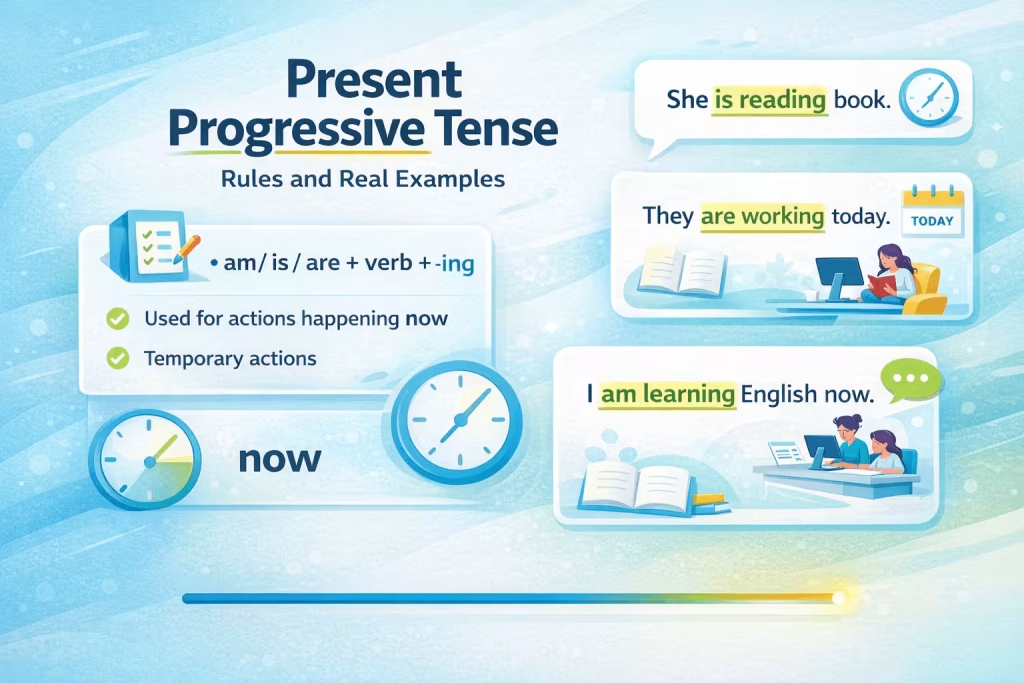
It’s the combination of the helping verb “to be” (am, is, are) plus a main verb with “-ing” at the end. Together, they create magic!
The Building Blocks: Form & Structure
1️⃣ Affirmative Form
| Subject | BE Verb | Verb + -ing | Example |
|---|---|---|---|
| I | am | working | I am working. |
| He/She/It | is | reading | She is reading. |
| You/We/They | are | playing | They are playing. |
2️⃣ Negative Form
Subject + am/is/are + not + verb(-ing)
- I am not sleeping.
- She isn’t working.
- They aren’t studying.
💡 In spoken English, contractions are strongly preferred:
- I’m not
- She’s not / She isn’t
- They’re not / They aren’t
3️⃣ Question Form
Am/Is/Are + subject + verb(-ing)?
- Are you studying?
- Is he coming?
- Am I interrupting?
Short answers:
- Yes, I am.
- No, she isn’t.
How to Add “-ING” Correctly
This is where many learners make spelling errors.
Standard Rule
Add -ing:
- play → playing
- talk → talking
Drop the Final “E”
- make → making
- drive → driving
Double Final Consonant (CVC Pattern)
If the verb:
- Has one syllable
- Ends in consonant-vowel-consonant
Then double it:
- run → running
- sit → sitting
- stop → stopping
⚠ Not all verbs double:
- open → opening (stress pattern matters)
Change “IE” to “Y”
- lie → lying
- die → dying
Present Progressive vs Simple Present
This is the most common confusion.
| Simple Present | Present Progressive |
|---|---|
| Permanent facts | Temporary actions |
| Habits | Happening now |
| Schedules | Changing situations |
Examples:
She is drinking coffee right now. (current action)
I work at Google. (permanent job)
I am working from home this week. (temporary)
She drinks coffee every morning. (habit)
Real Conversation Examples
Phone Call:
“What are you doing?”
“I’m just finishing dinner.”
Text Message:
“Sorry, I’m driving.”
Office Conversation:
“We’re working on a new project.”
Family:
“Mom is making pasta.”
Notice how natural contractions are in spoken English.
Examples Table: 20+ Real-Life Examples
| Subject | BE Verb | Main Verb + ing | Complete Sentence |
|---|---|---|---|
| I | am | studying | I am studying math. |
| You | are | watching | You are watching TV. |
| He | is | playing | He is playing football. |
| She | is | singing | She is singing beautifully. |
| It | is | raining | It is raining outside. |
| We | are | eating | We are eating pizza. |
| They | are | dancing | They are dancing together. |
| The dog | is | barking | The dog is barking loudly. |
| My friends | are | laughing | My friends are laughing. |
| The baby | is | sleeping | The baby is sleeping peacefully. |
| I | am | writing | I am writing a letter. |
| The birds | are | flying | The birds are flying south. |
| Mom | is | cooking | Mom is cooking dinner. |
| The students | are | listening | The students are listening carefully. |
| My brother | is | reading | My brother is reading comics. |
| The sun | is | shining | The sun is shining brightly. |
| We | are | learning | We are learning English. |
| The cat | is | jumping | The cat is jumping on the sofa. |
| They | are | building | They are building a sandcastle. |
| I | am | drawing | I am drawing a picture. |
| The children | are | playing | The children are playing in the park. |
Cultural & Context Notes
In American English, the present progressive is very common in casual conversation.
British English, usage is similar, but certain stative verbs are slightly more flexible in American speech (e.g., “I’m loving it.”).
In formal writing (academic essays), progressive forms are used less frequently unless describing trends or processes.
Pro Tip Section
If the action feels temporary, the progressive is likely correct.
If it feels permanent or habitual, use simple present.
When in doubt, ask: “Is this happening around now?”
Advanced learners: listen to how native speakers use progressive to add emotion or emphasis.
Exercises Section: Practice Makes Perfect!
A. Fill in the Blanks (10 questions)
- She _ (is/am/are) _ (read) a story.
- We _ (is/am/are) _ (play) in the garden.
- I _ (is/am/are) _ (write) an email.
- The dogs _ (is/am/are) _ (bark) loudly.
- He _ (is/am/are) _ (swim) in the pool.
- They _ (is/am/are) _ (watch) a movie.
- The baby _ (is/am/are) _ (cry).
- You _ (is/am/are) _ (do) great work!
- The teacher _ (is/am/are) _ (explain) the lesson.
- My friends _ (is/am/are) _ (come) to my party.
B. Identify the Correct Sentence (5 questions)
- Which is correct?
a) She singing a song
b) She is singing a song
c) She are singing a song - Which is correct?
a) They are play football
b) They is playing football
c) They are playing football - Which is correct?
a) I am studying hard
b) I is studying hard
c) I studying hard - Which is correct?
a) The cat are sleeping
b) The cat is sleeping
c) The cat am sleeping - Which is correct?
a) We are dance together
b) We dancing together
c) We are dancing together
C. Make Your Own Sentences (5 prompts)
- Make a sentence using “I am” + a verb
- Make a sentence using “She is” + a verb
- Make a sentence using “They are” + a verb
- Make a sentence about what you’re doing right now
- Make a sentence about what your friend is doing
Answer Key for All Exercises
A Section Answers:
- is, reading
- are, playing
- am, writing
- are, barking
- is, swimming
- are, watching
- is, crying
- are, doing
- is, explaining
- are, coming
B Section Answers:
- b) She is singing a song
- c) They are playing football
- a) I am studying hard
- b) The cat is sleeping
- c) We are dancing together
C Section Answers:
- I am learning English grammar.
- She is baking cookies.
- They are visiting the zoo.
- I am completing my exercises.
- My friend is reading a comic book.
Mini Quiz: Test Your Knowledge!
- True or False: “I am playing” is Present Progressive Tense.
- Multiple Choice: What’s the correct form?
a) He are running
b) He is running
c) He am running - True or False: We use Present Progressive for actions happening right now.
- Multiple Choice: Which BE verb goes with “They”?
a) am
b) is
c) are - True or False: “She playing tennis” is a complete sentence.
- Multiple Choice: How do you make “sit” into -ing form?
a) siting
b) sitting
c) siing - True or False: Present Progressive always needs a BE verb.
- Multiple Choice: What’s the negative of “I am reading”?
a) I am not reading
b) I not am reading
c) I no reading - True or False: “Is” goes with “You”
- Multiple Choice: Complete: “The birds _ flying”
a) am
b) is
c) are
Quiz Answers:
- True 2. b 3. True 4. c 5. False 6. b 7. True 8. a 9. False 10. c
Short Summary of Learning
Congratulations! You’ve mastered the Present Progressive Tense! Let’s quickly review what we learned:
Present Progressive shows actions happening RIGHT NOW
Formula: Subject + am/is/are + verb-ing
Use “am” with I, “is” with he/she/it, “are” with you/we/they
Always add -ing to the main verb
Perfect for describing current activities
Moreover, you can now confidently talk about what’s happening around you at any moment. Additionally, you understand how to form questions and negative sentences too!
Leave a Reply