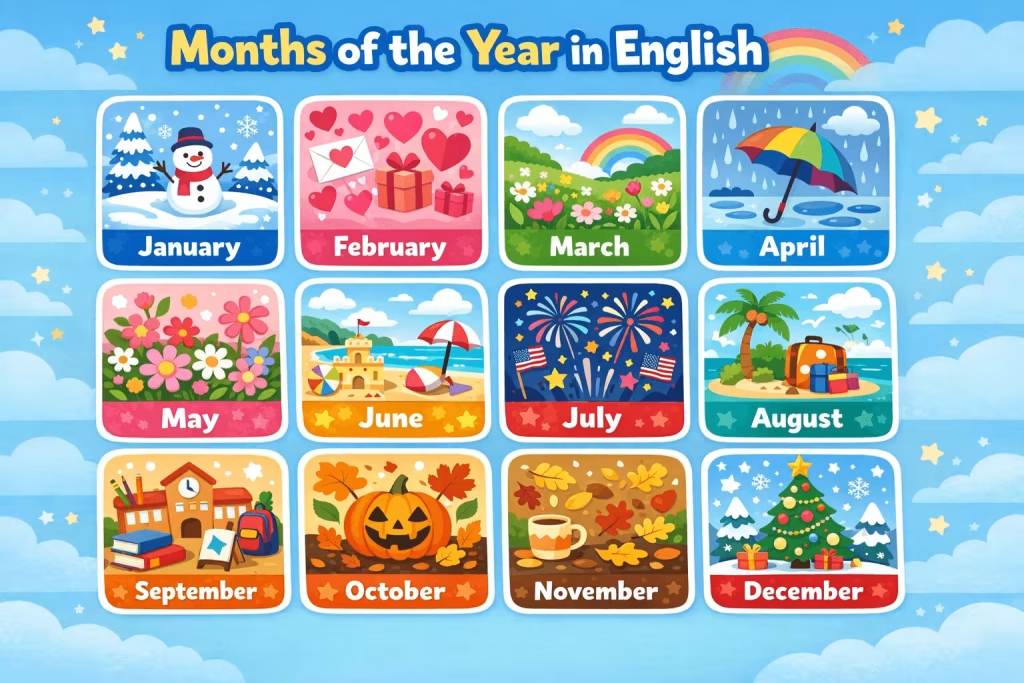
What Are the Months of the Year?
Every year is divided into 12 parts called months. Each month has its own number of days, weather, festivals, and special meanings.
In the modern Gregorian calendar (used internationally), months contain:
- 28, 29, 30, or 31 days
- A total of 365 days per year
- 366 days in a leap year
Learning the months in English helps us talk about birthdays, seasons, school schedules, holidays, and plans.
For example, we say:
- “My birthday is in June.”
- “We go back to school in September.”
In fact, learning the months of the year is one of the most important skills you’ll ever master. Therefore, today we’re going on an exciting journey to discover all twelve months and their special meanings!
Definition of Month
A month is one of the twelve parts that make up a year. It measures time and helps us organize days more easily.
Each month has between 28 to 31 days.
Together, they form one full year, just like 12 slices make a whole pizza!
The 12 Months in English (With Origins & Cultural Context)
| Month | Days | Origin | Cultural Associations |
|---|---|---|---|
| January | 31 | Named after Janus (Roman god of beginnings) | New Year’s resolutions |
| February | 28/29 | Possibly from Februa (purification festival) | Valentine’s Day |
| March | 31 | Mars (Roman god of war) | Start of spring (Northern Hemisphere) |
| April | 30 | From Latin aperire (“to open”) | Rain, blossoms |
| May | 31 | Maia (goddess of growth) | Spring peak |
| June | 30 | Juno (goddess of marriage) | Weddings |
| July | 31 | Julius Caesar | Summer vacations |
| August | 31 | Augustus Caesar | Travel season |
| September | 30 | Latin septem (seven) | Back-to-school |
| October | 31 | Latin octo (eight) | Halloween |
| November | 30 | Latin novem (nine) | Thanksgiving (USA) |
| December | 31 | Latin decem (ten) | Christmas, holidays |
Why Are September–December “Wrong” Numbers?
You may notice:
- Septem = 7
- Octo = 8
- Novem = 9
- Decem = 10
But they are now months 9–12.
This happened because the ancient Roman calendar originally started in March. Later, January and February were added to the beginning.
This historical shift explains the mismatch.
Rules and Patterns: Master the Months!
Essential Rules to Remember:
- Always capitalize the first letter of each month
- Never use “the” before a month name
- Usually use “in” before months (in January, in February)
- Remember the order never changes
Helpful Patterns:
1. Pattern: Days in Each Month
30 days: September, April, June, November
31 days: All others
28/29 days: Only February
2. Pattern: Memory Trick
"Thirty days has September,
April, June, and November.
All the rest have thirty-one,
Except February alone!"
2. Pattern: Writing Dates
American Style: Month/Day/Year (March 15, 2024)
British Style: Day/Month/Year (15 March 2024)
1. Capitalization Rule
Months are always capitalized because they are proper nouns.
✅ Correct:
- My birthday is in April.
❌ Incorrect:
- My birthday is in april.
This error is extremely common among learners whose first languages do not capitalize months (e.g., Spanish, French, German).
2. Prepositions with Months
Use “in” for months:
- in January
- in July
- in December
Example:
We moved here in August.
Use “on” for specific dates:
- on July 4th
- on March 15
Example:
The meeting is on October 3rd.
Use “this” / “next” / “last” without “in”:
❌ in next March
✅ next March
Example:
I’m traveling next June.
3. Articles and Months
We do not use “the” before month names:
❌ the January
❌ the December
However, we can use “the” when describing a specific one:
✅ the December of 2020 was difficult
This is an advanced nuance.
Writing Dates: American vs British English
Understanding date formatting is crucial in professional contexts.
American English Format:
Month + Day + Year
- March 15, 2024
British English Format:
Day + Month + Year
- 15 March 2024
Numeric difference:
- US: 03/15/2024
- UK: 15/03/2024
This difference causes real-world confusion in contracts and travel bookings.
Spoken vs Written English Differences
In natural conversation, months often sound different from their written forms.
Spoken Contractions:
- “I’ll see you in September.” → often reduced: in Sep-tem-ber
- “January” is often pronounced quickly: Jan-yoo-uh-ree
Learners frequently mispronounce:
- February → many natives say “Feb-yoo-ary” (dropping the first “r” sound)
Real Conversation Examples
Casual Conversation
A: When’s your birthday?
B: It’s in November.
Workplace Conversation
A: When can you finish the project?
B: By early September.
Academic Context
The conference will be held in April 2026.
Travel Planning
We’re flying out on July 18th.
Notice the shift between in and on.
Mini Quiz: Test Your Knowledge!
- How many months have 31 days? a) 5 b) 7 c) 6 d) 8
- True or False: February always has 28 days.
- Which month comes after August? a) September b) October c) July d) November
- True or False: All month names must start with a capital letter.
- April has ___ days. a) 28 b) 29 c) 30 d) 31
- The seventh month of the year is: a) June b) July c) August d) September
- True or False: December is the last month of the year.
- Which month is the shortest? a) January b) February c) November d) April
- Summer usually begins in: a) May b) June c) July d) August
- True or False: October comes before September.
Quiz Answers: 1-b, 2-False, 3-a, 4-True, 5-c, 6-b, 7-True, 8-b, 9-b, 10-False
Creative Activity: My Year Story!
Now, let’s create a fun story using all twelve months! Fill in this story with your own ideas:
“My Amazing Year Adventure”
In January, I started the year by _________. Then, in February, I celebrated _________. When March arrived, I _________. Next, April brought _________. In May, the flowers _________. Subsequently, June was perfect for _________. During July, I enjoyed _________. After that, August was full of _________. When September came, I _________. Meanwhile, October surprised me with _________. In November, I felt thankful for _________. Finally, December ended my year with _________!
Cultural & Contextual Notes
Understanding months also means understanding global usage.
Fiscal Years
In some countries, the fiscal year starts in:
- April (UK, India)
- October (US government)
Academic Years
School often begins in:
- September (Europe, US)
- April (Japan)
Months are deeply connected to cultural systems.
Summary: What We’ve Learned Today!
Congratulations! You’ve mastered the twelve months of the year! In summary, you now know:
- All twelve months in perfect order
- How many days each month contains
- How to write and use months correctly
Most importantly, you understand that months help us organize time, plan events, and communicate clearly about when things happen. Therefore, you’re ready to use this knowledge every single day!
Because they are proper nouns representing specific names in the calendar.
Use “in” with months and “on” with specific dates.
Due to historical calendar adjustments and leap year corrections.
Seven months: January, March, May, July, August, October, December.
American English: Month + Day + Year.
British English: Day + Month + Year.
Leave a Reply