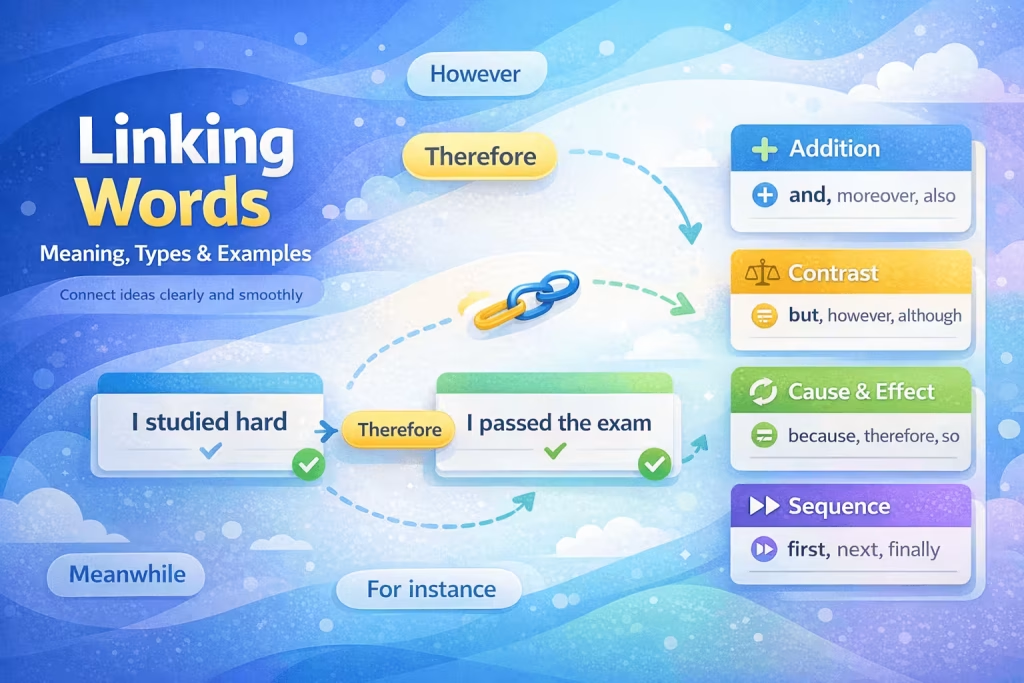
What Are Linking Words and Where Do We Use Them?
Have you ever noticed how some sentences sound smooth and easy to read, while others feel jumpy or broken?
The secret behind smooth writing and speaking is linking words, also called transition words.
We use linking words every day when we talk to friends, write stories, explain ideas in class, or even send messages online.
For example:
- I like ice cream because it is sweet.
- It was raining; however, we still played.
Without linking words, language feels confusing and unfinished. With them, ideas flow like a story.
Definition:
Simple Definition
Linking words act like friendly helpers that join one idea to another.
Another Easy Way to Understand
Think of linking words as:
- Glue that joins ideas
- Bridges between sentences
- Traffic signals that guide the reader
Even Simpler!
Linking words tell us:
- Why something happens
- When it happens
- What comes next
- How ideas are related
Step-by-Step Breakdown
Let’s break this down slowly and clearly.
Step 1: Sentences Have Ideas
Every sentence has an idea.
Example:
- I was tired.
Step 2: We Often Have More Than One Idea
- I was tired. I finished my homework.
Step 3: Linking Words Join These Ideas
- I was tired, but I finished my homework.
Now the sentence is smoother and clearer!
Types of Linking Words (Transition Words)
Linking words are grouped by purpose. Each type has a job.
Examples Table (20+ Examples)
| Type | Linking Word | Example Sentence |
|---|---|---|
| Addition | and | I like apples and bananas. |
| Addition | also | She is kind also helpful. |
| Addition | moreover | It was cheap; moreover, it was useful. |
| Cause | because | I stayed home because it was raining. |
| Cause | since | Since you are here, let’s start. |
| Result | so | I was late, so I ran fast. |
| Result | therefore | It rained; therefore, we stayed in. |
| Contrast | but | I am small but strong. |
| Contrast | however | It was cold; however, we swam. |
| Contrast | although | Although he is young, he is wise. |
| Time | before | Wash your hands before eating. |
| Time | after | We played after school. |
| Time | meanwhile | I cooked; meanwhile, she cleaned. |
| Sequence | first | First, open the book. |
| Sequence | next | Next, read the page. |
| Sequence | finally | Finally, answer the questions. |
| Example | for example | I like fruits, for example, apples. |
| Example | such as | Animals such as cats are cute. |
| Condition | if | If it rains, stay inside. |
| Condition | unless | Don’t go unless I say so. |
Rules + Patterns (Easy Grammar Guide)
Basic Rules
- Use one linking word to connect ideas clearly
- Do not repeat the same linking word too often
- Choose the linking word based on meaning, not habit
Sentence Patterns
- Cause → Result
- Because + reason, result
- I stayed home because I was sick.
- Contrast
- Sentence, but sentence
- I like tea, but I love coffee.
- Sequence
- First → Next → Then → Finally
Why Linking Words Matter in Real Life
Linking words help you:
- Write better essays
- Speak clearly and confidently
- Tell better stories
- Think in an organized way
Without them, your ideas feel broken.
With them, your ideas feel powerful.
Common Mistakes (And Fixes)
Mistake 1: Using the Wrong Linking Word
❌ I was tired because I slept early.
✅ I was tired although I slept early.
Mistake 2: Using Too Many
❌ And then and so but then because…
✅ Use only one when needed.
Mistake 3: Starting Every Sentence with “And”
✅ Try: However, Therefore, Also, First
Exercises Section (20 Questions)
A. Fill in the Blanks (1–10)
- I was hungry, ___ I ate food.
- He ran fast ___ he was late.
- I like animals ___ dogs and cats.
- ___ it was raining, we stayed home.
- She studied hard; ___, she passed.
- Brush your teeth ___ sleeping.
- ___ open the book, then read.
- I wanted to go, ___ I was sick.
- You can play ___ you finish homework.
- He is small ___ strong.
B. Choose the Correct Word (11–15)
- (but / because) – I like cake ___ it is sweet.
- (however / and) – It was hot; ___ we went out.
- (first / because) – ___, wash your hands.
- (so / although) – I was tired, ___ I slept.
- (for example / but) – I like fruits, ___ apples.
C. Make Your Own Sentences (16–20)
- Use because
- Use however
- Use first
- Use although
- Use so
Answer Key
- so
- because
- such as
- Because
- therefore
- before
- First
- but
- after
- but
- because
- however
- first
- so
- for example
(16–20: student answers may vary)
Mini Quiz (10 Questions)
Choose the correct answer
- Which word shows contrast?
A) and B) but C) so
✔ B - “Because” shows:
A) result B) time C) reason
✔ C - True or False: Linking words make writing clearer.
✔ True - Which is for sequence?
A) however B) first C) because
✔ B - “So” shows:
A) result B) example C) time
✔ A
6–10: (Teacher-guided or self-check)
Creative Activity: Story Builder for Kids
Story Starter
First, I woke up early.
___ I brushed my teeth.
___ I ate breakfast.
___ I was late, I ran fast.
Finally, I reached school happy.
Fill the blanks with linking words and create your own story!
Summary of Learning
Linking words teach our ideas how to walk together instead of standing alone. They help sentences move smoothly, showing when something happens, why it happens, or how one thought changes into another. Without linking words, language feels choppy and confusing; with them, meaning becomes clear and friendly.
By learning linking words, we learn how to organize our thoughts, not just our sentences. We discover how to add ideas, compare them, explain reasons, show results, and tell stories in the right order. These small words give big power to writing and speaking.
Linking words connect ideas
They make speaking and writing smooth
Different types have different jobs
Using them correctly improves confidence and clarity
Leave a Reply