What Is Direct and Indirect Speech?
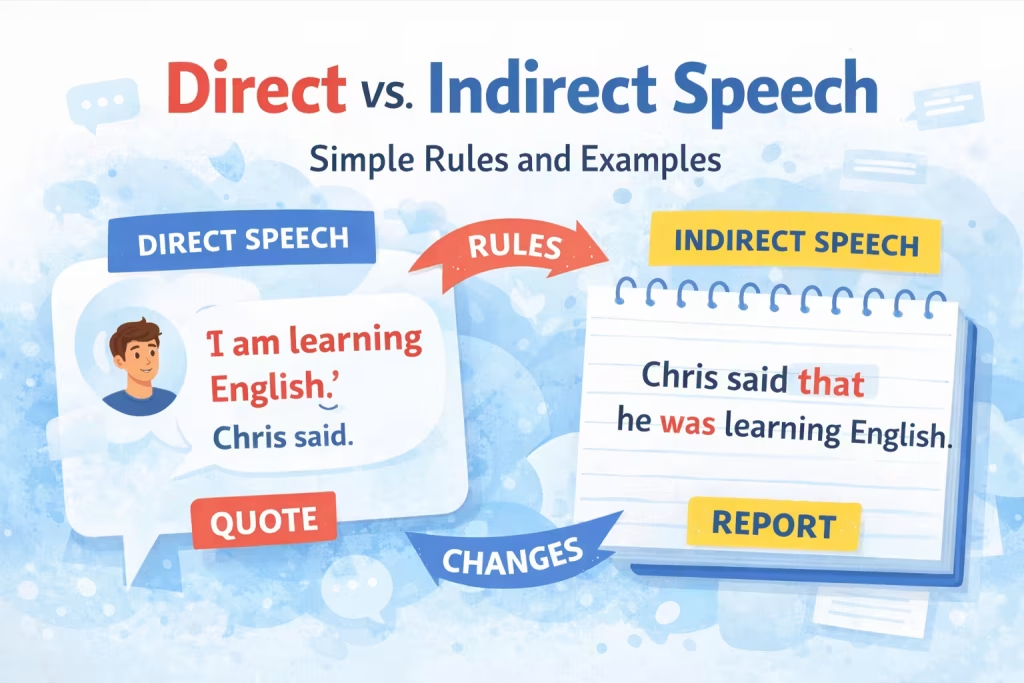
In our daily life, we often talk about what other people say. For example, you may hear your friend telling a story, or you might read news where someone’s words are reported. In such cases, English uses two special ways to share speech: Direct Speech and Indirect Speech. For example, you might say:
Ali said, “I am tired.”
Or you might tell someone:
Ali said that he was tired.
Although both sentences share the same meaning, they are written in different ways. Therefore, this lesson is all about Direct Speech and Indirect Speech two simple but powerful grammar tools that help us report what someone else has said.
Moreover, we use direct and indirect speech in stories, conversations, school exams, news, emails, and daily life. So, learning this topic makes your English clearer, smarter, and more confident.
Definition Section: Simple Meanings in Many Ways
What Is Direct Speech?
Direct speech tells exactly what a person said, using quotation marks (“ ”). The speaker’s words are written exactly as they were said.
She said, “I am happy.”
What Is Indirect Speech?
Indirect speech tells us what someone said, but not in the exact words. Instead, the meaning stays the same while the form changes.
She said that she was happy.
So, indirect speech reports the message smoothly and clearly.
Step-by-Step Understanding
Now, let’s understand this topic slowly and carefully.
Step 1: Look at the Original Sentence
First of all, read the direct speech carefully. After that, identify who is speaking and what they are saying.
Step 2: Remove Quotation Marks
Next, when changing to indirect speech, remove the quotation marks completely. At the same time, add the word that (optional but helpful).
Step 3: Change Pronouns
Then, change pronouns according to the speaker.
- I → he / she
- my → his / her
As a result, the sentence matches the new speaker.
Step 4: Change the Tense
Finally, move the tense one step back. Therefore, present tense usually becomes past tense.
Direct Speech Explained Clearly
Direct speech is very easy because it copies the speaker’s exact words.
Important Points to Remember
- Quotation marks (“ ”) are always used
- The first letter inside quotes is capital
- Commas and punctuation stay inside the quotes
Example
She said, “I will help you.”
Here, the sentence is written exactly as spoken.
Indirect Speech Explained Clearly
Indirect speech, on the other hand, changes the structure while keeping the meaning.
Important Points to Remember
- Quotation marks are removed
- Pronouns usually change
- Verb tense often changes
Example
She said that she would help me.
Because of these changes, indirect speech sounds more formal and smooth.
Direct vs. Indirect Speech (20 Examples)
| No. | Direct Speech | Indirect Speech |
|---|---|---|
| 1 | He said, “I am tired.” | He said that he was tired. |
| 2 | She said, “I like milk.” | She said that she liked milk. |
| 3 | Ali said, “I will come.” | Ali said that he would come. |
| 4 | “I can swim,” he said. | He said that he could swim. |
| 5 | She said, “I have a pen.” | She said that she had a pen. |
| 6 | He said, “I am reading.” | He said that he was reading. |
| 7 | “I may help you,” she said. | She said that she might help me. |
| 8 | Tom said, “I play cricket.” | Tom said that he played cricket. |
| 9 | “I am late,” he said. | He said that he was late. |
| 10 | She said, “I will call you.” | She said that she would call me. |
| 11 | “I need water,” said the boy. | The boy said that he needed water. |
| 12 | She said, “I have finished.” | She said that she had finished. |
| 13 | “I am going home,” he said. | He said that he was going home. |
| 14 | She said, “I like music.” | She said that she liked music. |
| 15 | He said, “I can help.” | He said that he could help. |
| 16 | “I am sad,” said the girl. | The girl said that she was sad. |
| 17 | She said, “I will study.” | She said that she would study. |
| 18 | “I have a cat,” he said. | He said that he had a cat. |
| 19 | She said, “I am hungry.” | She said that she was hungry. |
| 20 | “I like ice cream,” Tom said. | Tom said that he liked ice cream. |
Rules and Sentence Patterns
Basic Structure
- Direct: Subject + said, “Sentence”
- Indirect: Subject + said that + changed sentence
Common Tense Changes
- am / is → was
- are → were
- will → would
- can → could
- have → had
Time Word Changes
- today → that day
- tomorrow → the next day
- yesterday → the day before
Because of these rules, accuracy becomes much easier.
Why Direct and Indirect Speech Is Important in Real Life
Direct and indirect speech are important because:
- They help you tell stories clearly
- They improve writing skills
- They are common in exams
- They make conversations polite and natural
Therefore, mastering this topic is a big step toward fluent English.
Common Mistakes and How to Fix Them
Mistake 1: Not Changing the Tense
❌ He said that he is busy.
✔ He said that he was busy.
Mistake 2: Using Quotation Marks
❌ She said that “she was happy.”
✔ She said that she was happy.
Mistake 3: Wrong Pronouns
❌ He said that I was late.
✔ He said that he was late.
Exercises Section
A. Fill in the Blanks (10)
- She said that she ___ happy.
- He said that he ___ football.
- Ali said that he ___ come.
- She said that she ___ a book.
- He said that he ___ swim.
- She said that she ___ tea.
- Tom said that he ___ tired.
- She said that she ___ reading.
- He said that he ___ help.
- She said that she ___ finished.
B. Choose the Correct Sentence (5)
- a) He said that he is ready.
b) He said that he was ready. - a) She said she will come.
b) She said she would come. - a) He said that he can run.
b) He said that he could run. - a) She said that she likes cake.
b) She said that she liked cake. - a) He said that I was late.
b) He said that he was late.
C. Make Your Own Sentences (5)
16–20. Change these into indirect speech:
- “I am hungry.”
- “I like books.”
- “I will help.”
- “I can sing.”
- “I have a toy.”
Answer Key
- was
- played
- would
- had
- could
- liked
- was
- was reading
- needed
- had
- b
- b
- b
- b
- b
Mini Quiz (True / False)
- Direct speech uses quotation marks. (True)
- Indirect speech uses exact words. (False)
- “Will” changes to “would”. (True)
- Pronouns change in indirect speech. (True)
- Indirect speech is used in stories. (True)
- Quotation marks stay in indirect speech. (False)
- Tenses often move back. (True)
- This topic helps exams. (True)
- Direct speech changes words. (False)
- This lesson is useful daily. (True)
Creative Activity: Story Builder
First, write 5 direct speech sentences.
Then, change them into indirect speech.
As a result, your grammar skills will improve quickly.
Short Summary
In this lesson, you learned:
- The meaning of direct and indirect speech
- Step-by-step rules
- Common mistakes and solutions
- Practice through exercises and quizzes
Therefore, you are now more confident in English grammar.
Leave a Reply