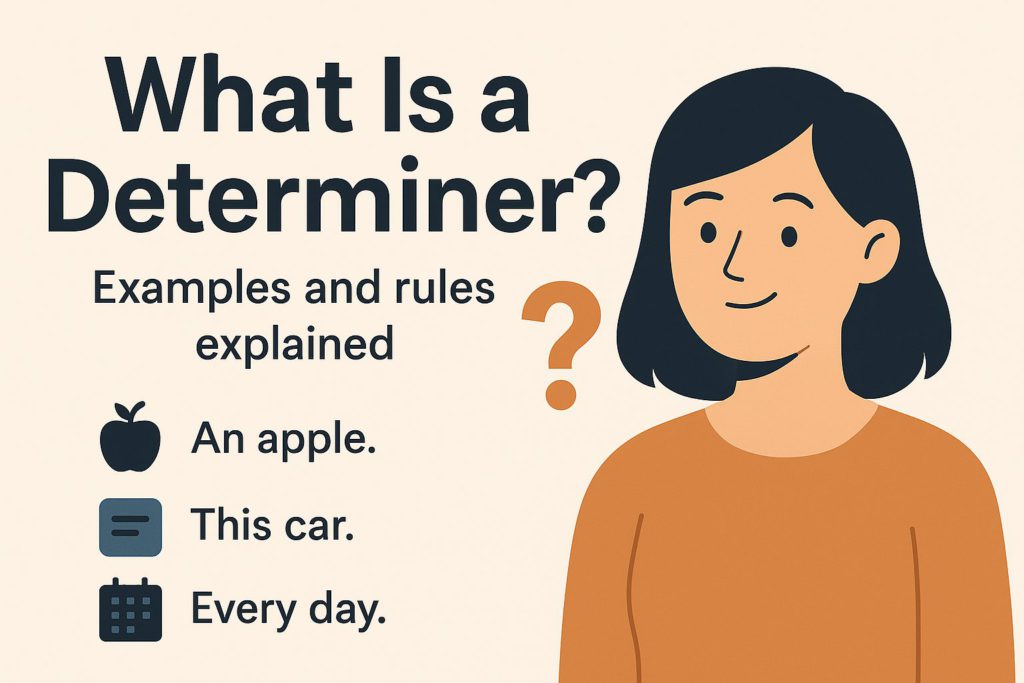
Language is full of small words that play big roles, and one such group is determiners. If you’ve ever wondered why we say “the cat” instead of just “cat,” or how we know whether to use “some,” “many,” “this,” or “my,” you’re thinking about determiners. This article will break down exactly what determiners are, why they matter, and how to use them like a pro, even if you’re just starting out with English grammar.
What Is a Determiner?
A determiner is a word that comes at the beginning of a noun phrase and helps to show which or how many people or things we are talking about. In simple terms, determiners make nouns more specific. They tell us if we’re referring to something definite or indefinite, how much or how many, or even who something belongs to.
Example:
- “I saw a dog in the park.” (The determiner “a” tells us it’s any dog, not a specific one.)
- “The dog barked loudly.” (Now “the” refers to a specific dog, perhaps one we already mentioned.)
Without determiners, sentences can sound incomplete or confusing. Imagine saying, “I want apple,” instead of “I want an apple.” Determiners help us communicate more clearly.
Why Are Determiners Important?
Determiners play a key role in English because they:
- Specify which thing or things we mean
- Show ownership or quantity
- Help sentences make sense
They are used so often that we barely notice them, but if you leave them out, your English will sound strange or incorrect.
Where Do Determiners Go in a Sentence?
Determiners almost always come before the noun. If there are adjectives, the determiner comes first, then the adjectives, then the noun.
Examples:
- “That big red balloon”
- “My favorite book”
- “Every interesting idea”
Main Types of Determiners
Let’s look at the different types of determiners and how to use them.
1. Articles
Articles are the most common determiners. There are two types:
- Definite article: “the”
- Refers to a specific person or thing.
- Example: “The movie we watched was great.”
- Indefinite articles: “a” and “an”
- Refer to any one item, not specific.
- Example: “I bought a car.” “She ate an orange.”
Tip: Use “a” before words that begin with a consonant sound (“a book”) and “an” before words that begin with a vowel sound (“an apple”).
2. Demonstratives
These determiners point to specific things or people.
- this, that, these, those
- “This” and “these” refer to things near you.
- “That” and “those” refer to things farther away.
Examples:
- “This chair is comfortable.”
- “Those shoes are new.”
3. Possessives
Possessive determiners show ownership or belonging.
- my, your, his, her, its, our, their
Examples:
- “My phone is charging.”
- “Their house is big.”
4. Quantifiers
Quantifiers tell us how much or how many.
- some, any, much, many, a lot of, few, little, several, all, both, each, every, no, enough
Examples:
- “Many students passed the test.”
- “She has a few friends.”
- “There isn’t much time left.”
5. Numbers
Numbers are also determiners when they come before a noun.
Examples:
- “Two cats sat on the wall.”
- “Thirty people attended the meeting.”
6. Interrogative Determiners
These are used to ask questions about nouns.
- which, what, whose
Examples:
- “Which color do you like?”
- “Whose jacket is this?”
Determiner Rules and Tips
Now that you know the types, let’s look at some rules and practical tips for using determiners correctly.
Rule 1: Use One Main Determiner Per Noun
Usually, you should not use more than one main determiner before a noun. For example, you wouldn’t say “the my book.”
Correct: “My book is on the table.”
Incorrect: “The my book is on the table.”
Rule 2: Determiners Come Before Adjectives
If there are adjectives, the determiner comes first, then the adjectives, then the noun.
Example:
- “Her beautiful new dress”
Rule 3: Articles and Possessives Don’t Mix
You cannot use both an article and a possessive before the same noun.
Incorrect: “The my friend is here.”
Correct: “My friend is here.”
Rule 4: Using Quantifiers With Articles
Some quantifiers can be used with articles, but the order matters.
Example:
- “A few apples”
- “The many problems we faced”
Rule 5: Choosing the Right Determiner
Think about what you want to say. Are you talking about something specific or in general? Do you need to show ownership or quantity? Pick the determiner that fits your meaning.
Examples:
- “All students must submit their work.”
- “Some people enjoy spicy food.”
- “Which book did you read?”
Putting It All Together: Examples in Real Sentences
Let’s see how determiners work in actual sentences. Notice how they help clarify meaning.
- Articles:
- “A bird is singing.”
- “The bird is beautiful.”
- Demonstratives:
- “This lesson is easy.”
- “Those questions are difficult.”
- Possessives:
- “His car is fast.”
- “Our garden is green.”
- Quantifiers:
- “Few people know the answer.”
- “Most children like ice cream.”
- Numbers:
- “Three dogs played in the yard.”
- “Ten students volunteered.”
- Interrogatives:
- “Which movie do you want to see?”
- “Whose pencil is this?”
Notice how removing the determiner from these sentences often makes them unclear or ungrammatical.
Common Mistakes With Determiners
Let’s look at some frequent errors beginners make and how to avoid them.
1. Using more than one main determiner:
- Incorrect: “The my shoes are new.”
- Correct: “My shoes are new.”
2. Forgetting the determiner:
- Incorrect: “I bought car yesterday.”
- Correct: “I bought a car yesterday.”
3. Mixing up “a” and “an”:
- Incorrect: “I saw a elephant.”
- Correct: “I saw an elephant.”
4. Using “some” with singular countable nouns:
- Incorrect: “I need some apple.”
- Correct: “I need an apple.” OR “I need some apples.”
Quick Reference Table: Common DeterminersTypeExamplesArticlea, an, theDemonstrativethis, that, these, thosePossessivemy, your, his, her, its, our, theirQuantifiersome, any, much, many, few, severalNumberone, two, three, etc.Interrogativewhich, what, whose
Practice: Try These Yourself
Fill in the blanks with an appropriate determiner:
- ___ apple a day keeps the doctor away.
- Can I borrow ___ pen?
- ___ friends are coming over tonight.
- ___ house is that?
- I have ___ idea!
Answers:
- An
- a
- My/Our/Some/Several (many answers possible)
- Whose
- an
Conclusion
Determiners are small but essential words that make your English clearer and more precise. Whether you’re talking about one thing or many, something specific or general, or asking a question, determiners help your listener understand exactly what you mean. By recognizing the types of determiners and following simple rules, you’ll be more confident in your writing and speech. Practice using determiners in your own sentences, and soon they’ll become second nature!
Leave a Reply